
Context
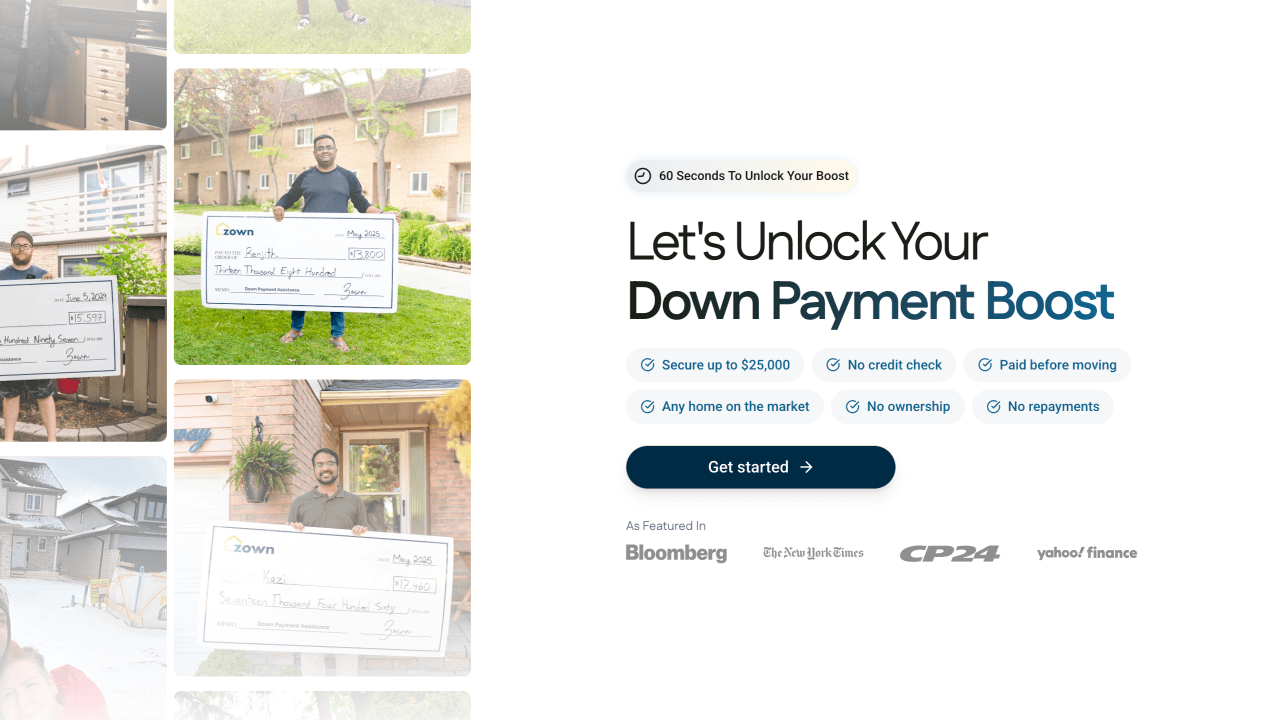
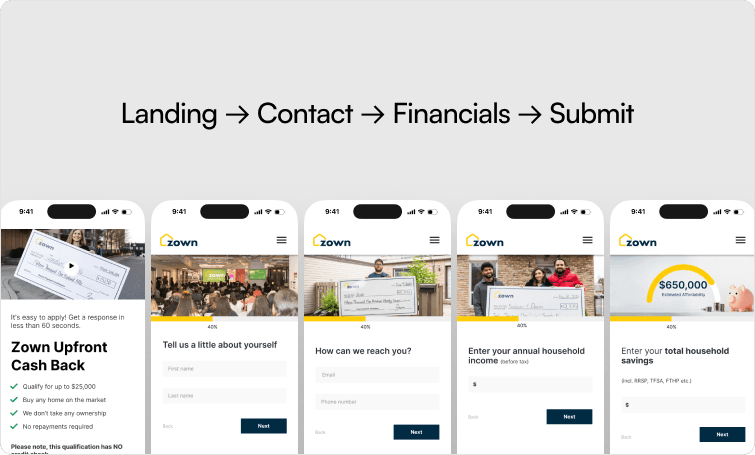
Zown is a real estate platform that helps first-time homebuyers get into the market. The qualification form is the main entry point to the business. It collects financial information like income, savings, credit score, and timeline to determine which services a customer is eligible for, including a no-cost down payment boost.
The form was also how we segmented customers into tiers based on their likelihood to close, and how we fired conversion events back to Facebook & Google Ads for targeting and attribution.
The Problem
The Cliff
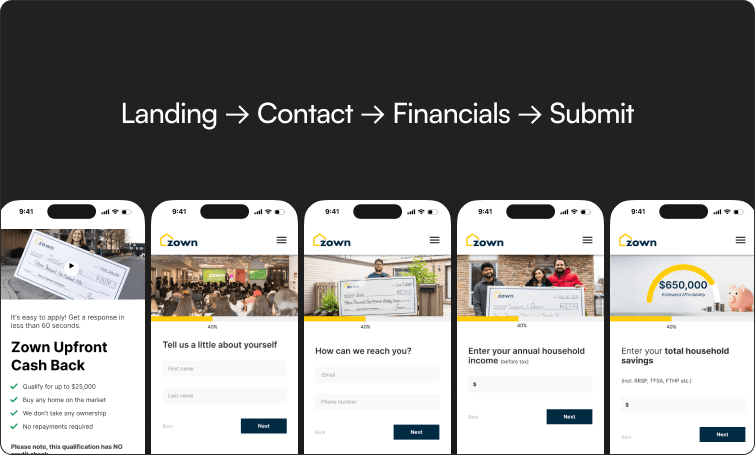
The form had a 60% drop-off between step 1 and step 2. Out of every 100 visitors who started, only 40 made it past the first step. Most users never made it far enough for us to explain what we did or why it was worth their time.
You might guess this was because we were asking for sensitive financial information, be it income, savings, or credit score, given the real estate industry. But these people were giving up on their name & contact information.
The Business Problem
As we looked to optimize cost of acquisition and scale the business, this early drop-off became expensive fast.
| Problem | Impact |
|---|---|
| Leverage | Optimizing later steps was capped. A 30% lift on ~350 remaining users had less impact than widening the top of the funnel. |
| Targeting | Users left before giving us any data, weakening signals for our ad platforms. |
| Funnel Health | Losing 65% immediately gave no time to build trust or explain the product. |
The First Test
MVP Experiment
Before investing in research, we tested the cheapest hypothesis first: a simple reorder of the form steps. If users had more time to understand the value proposition before we asked for personal information, they might convert at a higher rate. A quick swap would tell us if timing alone was the issue in less than a day.
H₀: Reordering steps will not significantly change conversion rate.
H₁: Moving financial questions before personal info will increase conversion.
It wasn't timing. Conversion dropped by 12%, with 99% statistical significance. The obvious fix made things worse. Normally, the experiment would have ended, but, it exposed something we couldn't see before.
Signs of life
Users who dropped off were now reaching Step 7 instead of Step 2. We were retaining them long enough to capture segmentation data on 67% of visitors, up from 30%, a 2.3x increase in signals we could feed back into retargeting.
Before
30 of 100 visitors identifiable
After
67 of 100 visitors identifiable
| Metric | Before | After | Change |
|---|---|---|---|
| Conversion | Baseline | -12% | Negative |
| Segmentation capture | 30% | 67% | +2.3x |
| Drop-off depth | Step 2 | Step 7 | Positive |
The reorder failed as a fix, but it proved the problem was worth digging into. We needed to understand why users were dropping off.
Research
Understanding why
The form asked for personal information immediately, with no value offered in return. Unlike a mobile app where users have already invested in downloading and signing in, a web form from an unfamiliar business has zero built-in trust.
Users were rejecting the order of the form.
They were rejecting being asked for personal info without context or value shown first.
Phone number friction
13 of 47 users didn't understand why a phone number was needed
No value exchange
17 of 47 users felt uneasy giving info before seeing value
Product skepticism
5 of 52 call transcripts reflected confusion about the no-repayment down payment boost
Solution
Improving trust through design
The failed experiment & user research clarified the real issue. Users weren't rejecting the order of the form, they were rejecting being asked for personal information without context. We needed to earn trust before making the ask.
Try it yourself
What is your annual household income?
Before taxes, just an estimate, no documents needed to calculate your boost.
As a first-time homebuyer, I wasn’t sure what to expect, but working with Zown made the whole process easy and stress-free. They were clear, helpful, and always quick to respond.
Reducing friction
Alongside the trust elements, I cut the form from 10 → 8 steps. The same research showed users wanted fewer asks and more context for the asks that remained.
Social Proof
I pulled testimonials directly from Google Reviews and surfaced them as cards within the form flow. I chose Google reviews specifically because they're third-party verified, users can easily check the source to find the social proofing.
The goal wasn't persuasion, but reassurance: showing that other people had gone through this process and found it worth their time.
Transparency
I added expandable drawers that explained why we were asking for specific pieces of information and how they would be used. Instead of simply requesting a phone number, we explained the purpose behind it.
This gave users context for the trade they were being asked to make.
Results
Earning trust earlier in the flow didn't just improve conversion. It changed the quality and economics of the entire funnel.
| Metric | Before | After | Change |
|---|---|---|---|
| Total conversion | 25.4% | 31.8% | +25.2% |
| Target customer conversion | 17.7% | 24.5% | +38.5% |
| Additional leads / week | — | 108 | +108 |
| Incremental weekly revenue | — | $37K | +$37K |
All results measured at 99% statistical significance. The cliff that cost us 65% of visitors on the first two steps flattened into a gradual decline across the flow, and this work became the foundation for future qualification experiments and improved ad efficiency across the funnel.